|
(I.) Ryoshin-Kan
Karate School Styles
Ryoshin-Kan (Dragon Spirit Training Hall) Dojo Style of Martial Arts are a unique blend of Sensei
Tim Thompson's studies of Shorin-Ryu, Shito-Ryu, Goshinjitsu, Jiu-Jitsu, Kobudo, Kenjitsu and his career military background.
His teachings include traditional training and Sports Martial Arts, as well as practical applications of these disciplines.
|
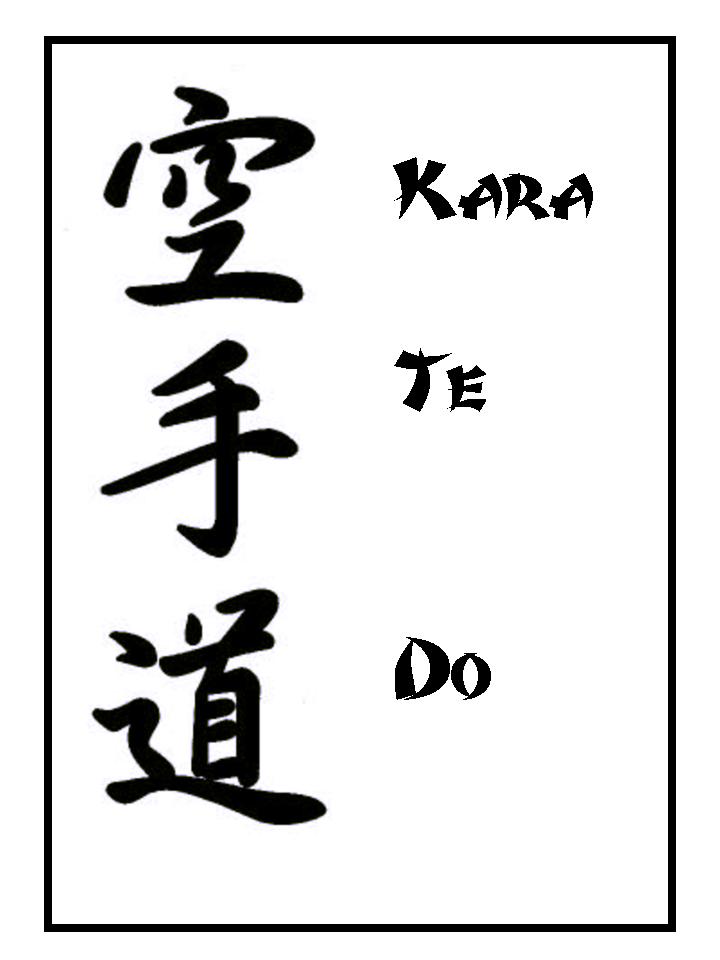
| Karate-Do |
Shorin-Ryu Karate-Do This system stems from the lineage of Anko
Itosu by way of Chosin Chibana and Shoguro Nakazato (Small Forest Way). The identifying techniques include blocks, punches,
kicks, Open hand strikes, elbow strikes, tuite,traditional stances and Tameshiwari, but is best known for it's fast and penetrating
multiple hand strikes.
|
| Kobudo & Kenjitsu |
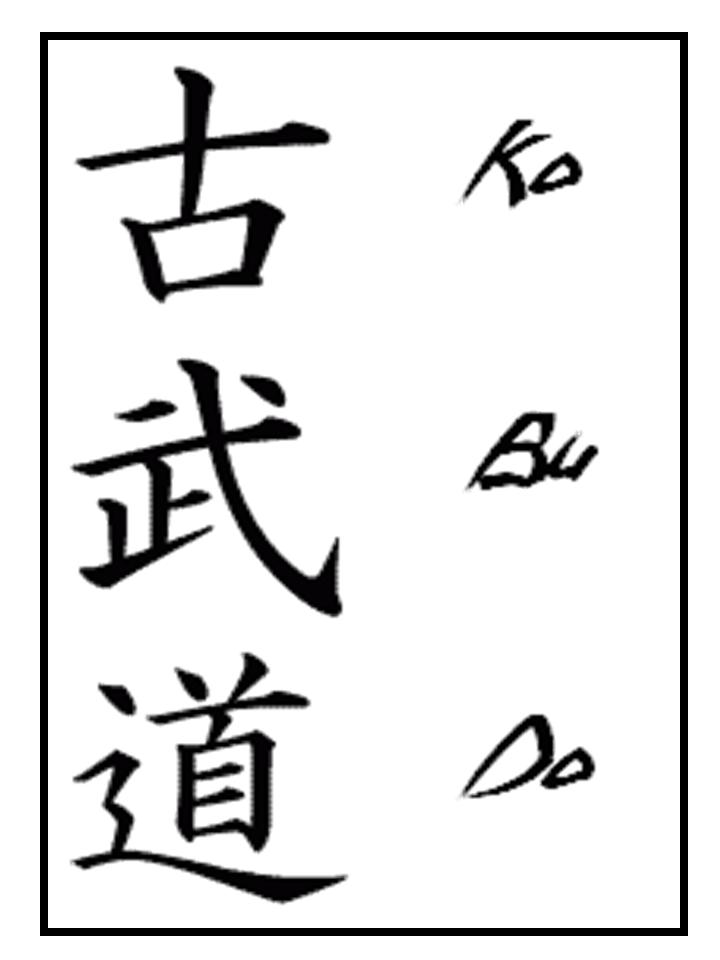
Okinawan/Japanese Kobudo The study of Okinawan farm tools used as
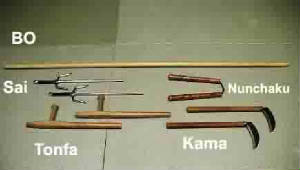
weapons. Includes the bo, tonfa, nunchaku, sai and kama as well as the jo, handbo, pr24, baton, double sticks and others.
Tsuru-Ha Kobudo A Shito-Ryu weapon system influenced by Soke Kuniba
and taught by its founder Shihan / Dr. James Herndon.
|
| The Five Main Weapons of Okinawan Kobudo |
|
| Goshin-Jitsu |
Ryoshin-Kan Goshin-Jitsu
(from the Japanese words Goshin meaning "protection of the body" and Jitsu meaning "techniques")
is an Award winning and very unique, advanced Self-Defense system created by Shihan Tim Thompson. The system
has earn National Championship and Hall of Fame Status. This Goshin-jitsu system consist of a blending of traditional &
modern martial arts utilizing strikes, punches, full range of kicks, joint locks, trapping, Scissor Takedowns, submissions,
various takedowns, sweeps, reaps, throws, disarment, falling and rolling techniques. It is well known for its multiple hand
strikes that are fast and penetrating followed by a take down. Goshin-Jitsu's purpose is to teach effective Self-Defense to
students of different skill levels for a wide range of real world scenarios. The concepts and techniques of Goshin-Jitsu originate
from a number of Martial Arts styles, from which the best and most effective techniques were taken. These skills are integrated
so that the elements build upon and incorporate one another to form a comprehensive and effective system of advance Self-Defense.
Goshin-Jitsu emphasizes techniques that can be used effectively in the real world as a means of self-protection for Men, Women
and Children. This Style of Goshin-Jitsu is also popular for those that like to do Demos and Tournaments. Shihan Thompson
has incorporated all of his knowledge, training, championships, seminars, clinics, Hall of Fames, and experience from the
last thirty plus years into this Ryoshin-Kan Goshin-Jitsu System. The Three Levels of Ryoshin-Kan Goshin-Jitsu are Basic,
Black Belt & Specialized.
Ryoshin-Kan Kenjutsu (Kenjitsu): "Art of the Samurai
sword." An aggressive method of swordsmanship practiced by the Japanese Samurai in which the combatants
pitted naked blade against naked blade. The Samurai Sword was called a Katana and it had a curved, single-edged blade twenty-four
to thirty-six inches long.The Ryoshin-Kan Kenjutsu was developed by Sensei Tim Thompson and it is a combination of Samurai
Sword Techniques / philosophies from The Kuniba-Ha and Yamashita –Ha systems. The Ryoshin-Kan Kenjutsu system has Sword
Cuts, sets, Kata and complexes. Kenjutsu practice has many things to offer, it may not seem very practical by looking at the
surface. It is true that you will probably never get in a sword fight. But learning how to use the sword has many other benefits,
besides fantasizing about being a samurai and fighting a duel to the death. The Practice of Kenjutsu will improve your Kime
(focus) as well as stances; foot work, physical conditioning and Self-Defense Awareness.
|
| Click photo to visit Demo Team Page |
Ryoshin-Kan
X-Treme Martial Arts
A very unique and dynamic System created by Sensei Tim Thompson, that blends Martial Arts with dynamic Acrobatics. This
system is designed for Sports Martial Arts Tournaments and Demo Teams. Students that perform well in both the traditional
and Sports Martial Arts are allowed to try out for the Dragon Force National Karate Demo Team.
Breaking Team and Clinics
Tameshiwari -“Breaking” The practice
of destroying bricks, boards, and other resistant materials with empty hand and foot techniques of the martial arts. Usually
as a test of kime / power and a display of showmanship at demos.
Breaking Clinics are conducted each month
at the Ryoshin-Kan Dojo in Virginia Beach, Virginia. The Participants are taught and perform breaking on wood boards, bricks,
patio blocks etc... All Students are taught Shihan Thompson's "Four Dynamics of Breaking, known as the F.I.S.T. Principle."
F.I.S.T. stands for
1. Focus/ Concentration
2. Intensity / Kiai
3. Speed / Snap
4. Technique / Follow Through
Breaking Team Practices and Competes at Martial
Arts Tournaments.
 (II.) Basic Martial Arts Terminology
Ryoshin-Kan - "Dragon Spirit Training Hall" Founded in 1980 by Sensei Tim Thompson. The
Ryoshin-Kan Karate School Mascot is a Dragon.
Ryoshin-Kan Motto - "Optimi Optimorum" that is
Latin for "The Best of the Best."
Dragonology - The Science and Study of Dragons.
Karate-Do – "Way of the empty hands” Although the art of karate or karate-do
dates back over a thousand years, it was in 1936 that the name was decided on. This was a result of a meeting between masters
Chomo Hanshiro, Choki Motobu, Chojun Miyagi and Chotoku Kyan. Until this time, the art was at times called karate as well
as To-te (Chinese hands).
Karateka – “student” A karateka is a person who studies or practices
the art of karate.
Dojo – "Place that you learn the Way" A dojo is the area karate is taught.
Because it is a ““sacred hall of learning”, respect and reverence should be awarded it at all times.
To bow in karate is a sign of respect and many of the traditional instructors will require students to bow upon entering the
school.
Shihan - Master Instructor
Sensei – “honorable teacher” A sensei is the senior instructor of a dojo.
In Chinese style dojos the term is “sifu”
Sempai - Senior Student
Kyoshi - "Grand Master" - Teacher Grade / Expert Instructor, A Japanese Martial Arts Teacher
who is 7th or 8th Dan (Degree Black Belt).
Hanshi - "Master of the Style" - A Japanese Martial Arts Teacher who is 9th or 10th Dan
(Degree Black Belt).
Kata – “forms” A stylized set of movements that use a variety of blocks
and strikes against an invisible opponent. A kata is used to perfect style, learn focus as well as demonstrating attack, defense
and counter attacks.
"The First move in every Kata is a Block,
symbolizing Self-Defense."
Basic Kata introduces the new student to a styles fundamental stepping, stancework, striking,
and other inherent principles. They teach one to look, adjust, then execute, rather than hurrying and rushing things.
Intermediate Kata introduces the student to broken rhythm, varied stepping, angling, body
and foot movement, sweeps, throws, locks, chokes and even groundfighting (or tuite).
Advance Kata introduces the student to the internal arts. This influence in advance karate
forms teach relaxation, fluidity, whipping power, speed / power in every movement, advance multiple techniques, increased
breath control, and Ki.
The empty hand Kata taught at the Ryoshin-Kan
Karate School are:>>> Numbered School Kata 1 to 10. Kihon
(Basics) Sho, Ni, San, Yon, Go and Rokudan. Fugyugata (Basic Kata) ichi & Ni. Empi ropu
(Elbow Routine). Shuto Kata (Knife hand). T-Kata (Basic) Pinon (Peaceful
movement)Shodan, Nidan, Sandan, Yondan and Godan. Naihanchi (Iron Horse) Shodan, Nidan, Sandan. Saifa
(smash & tear). Getsuryu (Moon Dragon) Shodan & Nidan. Jitte (10 Hands). Nijushiho
(24 moves). Chinto (Crane on a rock). Rohai (Vision of a Crane). Tamari Bassai(Tamari
style Penetrate a fortress). Passai (Penetrate a fortress)sho & dai. Kurunfa (Look-stop-Break)Kusanku
(Chinese Master)sho & dai, Kogaryu (Black Dragon).
**************************************
Animal Forms:
Monkey = coordination
Tiger = power
Praying Mantis = Trapping
Crane = Balance
Snake = speed
Dragon = spirit
Kihon - Basics - The Kihon forms 1-6 are instrumental in teaching the beginning student
the flavor and technique of Kobayashi Shorinryu.
FUGYUGATA ichi & Ni: (Fukyu kata) The word Fugyugata (fukyu) means fundamental / Basics.
These are two basic kata practiced by Okinawan Karate stylist. These katas are basic Shorin Ryu katas that introduce the student
to basic block, punches, takedowns and defense of central ground. This Kata also introduces the concept of defending all sides.
Defense movements are at 90 degree turns and 180 degree turns.
Fugyugata HISTORY: First Nagamine and Miyagi were asked to create two beginning forms.
The result was the Fugyugata Sho and Ni kata. Fugyugata Ichi is Shosin Nagamine's (founder of Matsubayashi Shorinryu) invention
and contribution to karate-do. Fugyugata Ni is Miyagi's creation and is referred to as Gekisai Sho (to destroy) in Goju Ryu.
Kumite-“free fighting” Kumite or “sparring” is when a two or more
martial artists fight each other.
Tameshiwari -“Breaking” The practice of destroying bricks, boards, and other
resistant materials eith empty hand and foot techniques of the martial arts. Usually as a test of kime / power and a display
of showmanship at demos.
Ghi – “uniform” There are different styles of a ghi depending on whether
you are studying Karate, Judo, or Aikido.
Obi - Karate Belt denotes rank (White, Gold, Purple, Green, Blue, Brown, Black)
Hachimaki - Karate Headband
Kiai – A forceful, deep-throated yell used to intimidate an opponent and focus your
power. Often used during katas to emphasize a technique.
Budo - Martial Arts
Bushido- “way of the warrior” An unwritten code of ethics, that is believed
to have been inspired by the samurai, Yoko Yamagei. It is similar to the European knight’s code for acts of chilvary.
Goshin-Jitsu - from the Japanese words Goshin meaning "protection of the body" and Jitsu
meaning "techniques" i.e. Advanced Self-Defense.
Kobudo - "Weapons" When Japan conquered Okinawa in the 1600s, the emperor forced the people
to give up all weapons. Having no way to defend themselves against the Samurai, they developed ways of using farm
implements for weapons. Most of the traditional martial arts weapons are still used for farming to this day. Nunchaku
– “flail” The nunchaku is without doubt the most well known of the weapons. It is basically two sticks connected
to each other by a string or chain. Their farming use was to beat the rice so it can be tossed on a large screen or piece
of material to allow the wind to blow away the husks. The nunchaku can be used as both an offensive and defensive weapon.
Bo-“staff” The Bo is a long wooden staff for herding livestock, guiding boats or used as a way
of carrying supplies in baskets. In this instance the bo was placed across the shoulders and the baskets would hang from either
side. Average length is 6’ with a diameter of 3.5 inches. There are two styles of the bo. The Chinese bo keeps an equal
diameter along its entire length where as the Okinawan style tapers at each end. Regardless of the style, its ends are used
to strike an opponent’s eyes, throat, and solar plexus of groin. It can also be used to block an attack as well as to
sweep the feet. Tonfa- Developed as a grinder for rice in Japan and soybeans in Okinawa, the Tonfa was found
to be affective when laid across the forearm as a way to block a sword or bo attack. Tonfas are made of hardwood, approximately
17 inches long with a 4.5 to 5 inch long handle near one end. The Tonfa is usually about 2 inches thick and has gained immense
popularity among law enforcement agencies. The police issue PR-24 are carried by countless police officers as a nightstick.
Kama – A razor sharp sickle that has a half-moon shaped blade and wooden handle. The Kama is still
used by farmers to cut rice and grass but is seldom taught as a weapon due to its dangerous nature. The kama is a defensive
weapon that was used against sword and bo attacks. It also becomes deadly when used as an extension of the users hands. In
hand to hand fighting, the kama is used to block a punch or kick but as it does so, the sickle blade can slash deeply into
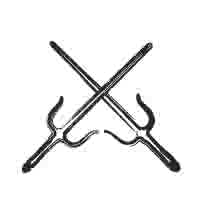
the arm or leg. Sai- (pronounced sigh) The sai was developed for planting rice or vegetable seeds. It resembles
a trident and has central, rounded or octagonal shaped steel blade approximately 16 inches long. On either side of the blade
there are two prongs that are wrist guards. Sais can be used for a number of things such as stabbing, slashing, punching,
blocking, and even throwing. It is believed that farmers who used the sai would carry three at a time. One sai for each hand
and one was kept in the belt to throw if necessary. Legend states a strap of some sort was occasionally tied to the handle
so the farmer could retrieve it. Not all weapons found in a dojo started out as farm tools. Jo – “short
staff” Developed by Muso Gonnosuke after suffering a defeat by swordsman Minamoto Muashi in the early 1600s. It is made
of hard wood and is 4 feet in length. This shorter length allowed close fighting with possibilities the longer bo can’t
allow. The jo can be used to choke, pin, lock, and throw an opponent. Years after his defeat, Muso once again faced Muashi
and came out of the match the victor. Manrikigusari- This weapon is a chain, which is usually 12 inches long.
It has weights on each end that resemble handles. A samurai by the name of Masaki developed the weapon as a way to kill an
opponent without bloodshed. This bloodless killing was important because it was sacrilege to spill blood on palace grounds.
The manrikigusari can be used to block, choke, strike, and throw an opponent. Shuriken – One of the
most popular of weapons is also known as the ninja throwing star. Initially developed to provide a distraction and not a weapon
of attack. Regardless of Hollywood magic, shurikens can injure but not penetrate deeply enough to kill. The most popular of
shuriken styles come in four to twelve points per star.
Kobujitsu – Okinawan term for fighting with weapons. Once a weapon is picked up,
the art is no longer karate because the hands are no longer empty.
Kenjitsu - "Art of the Samurai Sword (Katana)
- Chiburi: chi (blood) buri (flick). It is the techniques / process by which one removes blood
from their Katana (Samurai Sword). This is done before placing the blade back into the scabbard (known as noto).
Kyu – “boy” A Kyu is anyone who holds a level below black belt.
Dan – “man” Dan is used in regards to anyone who is a black belt. There
are several grades of dan.
KIME - Focus
OSU - Push ahead and never give up
Tournament - An event where martial artists of varying styles can come together to compete
in Kata, Kobudo, Tameshiwari, Kumite and Team events. In many tournaments the competitors will be broken up into rank classes
with trophies, medals, cash and other awards may be given to the winners.
COMMANDS:
Kiotsuke - Attention
Suwatte - Sit
Rei - Bow
Tatte - Stand
Yoi - Ready Position
Hajime - Begin
Yame - Stop
TECHNIQUES (Waza):
Dachi - Stance
UKE - Block
Tsuki / Ken - Punch
Uchi - Strike
Keri / Geri - Kick
LEVELS:
Gedan - Low
Chudan - Middle
Jodan - High
DIRECTIONS:
Mae - Front
Yoko - Side
Ushiro - Rear
Mawashi - Roundhouse
Stances
|
Heisoku Dachi |
Closed foot stance (feet together) |
|
Musubi Dachi |
Formal attention stance (heels together,
feet at an angle) |
|
Heiko Dachi |
Parallel stance (feet shoulder width apart) |
|
Migi Heiko Dachi |
Right foot forward Heiko Dachi |
|
Hachiji Dachi |
Natural stance (feet shoulder width apart,
toes pointed slightly out) |
|
Uchi Hachiji Dachi |
Natural stance with heels out and toes in |
|
Shiko Dachi |
Straddle leg stance |
|
Naname Shiko Dachi |
Diagonal straddle leg stance |
|
Kiba Dachi |
Horse riding stance |
|
Sanchin Dachi |
Hourglass stance |
|
Zenkutsu Dachi |
Front stance |
|
HanZenkutsu Dachi |
Half front stance |
|
Fudo Dachi |
Free stance |
|
Kokutsu Dachi |
Back stance |
|
Neko Ashi Dachi |
Cat foot stance |
|
Renoji Dachi |
The letter "Re" stance (or "L" stance) |
|
Sesan Dachi |
Side facing straddle stance |
|
Sagiashi Dachi |
Heron stance |
|
Bensoku Dachi. |
Cross-legged stance (also known as female
horse stance or Kosa Dachi) |
|
Naihanchi Dachi |
Kiba Dachi with the heels out and toes in |
Blocks
|
Gedan Barai |
Downward block |
|
Uchi Uke. |
Inside forearm block |
|
Soto Uke |
Outside forearm block |
|
Chudan Uke |
Inside circular block |
|
Jodan Uke |
Upward block |
|
Age Uke |
Rising block |
|
Shuto Uke |
Knife hand block |
|
Shotei Uke |
Palm heel block |
|
Shotei Otoshi Uke |
Open hand dropping block |
|
Yoko Uke |
Circular block |
|
Hiki Uke |
Pulling/grasping block |
|
Ko Uke |
Wrist block |
|
Gedan Uchi Barai |
Outside downward block (open hand) |
|
Ura Uke |
Back hand block |
|
Hiji Uke |
Elbow block |
|
Mawashi Uke |
Round house block |
|
Morote Uke |
Augmented block |
|
Sukui Uke |
Scooping block |
|
Nagashi Uke |
Sweeping block |
|
Kosa Uke |
Cross block |
|
Hiza Uke. |
Knee block |
|
Sokutei Osae Uke |
Pressing block with the sole of the foot |
|
Sokutei Harai Uke |
Sole of the foot block |
|
Haisoku Barai |
Instep block |
Hand Techniques (strikes and punches)
|
Seiken Tsuki |
Fore fist strike |
|
Oi Tsuki |
Lunge punch |
|
Gyaku Tsuki |
Reverse punch |
|
Age Tsuki |
Rising punch |
|
Nihon Tsuki |
Double punch |
|
Sanbon Tsuki |
Triple punch |
|
Kagi Tsuki |
Hook punch |
|
Yama Tsuki |
Mountain punch |
|
Awase Tsuki |
U-punch |
|
Heiko Tsuki |
Parallel punch |
|
Hasami Tsuki |
Scissors punch |
|
Nagashi Tsuki |
Flowing punch |
|
Nakadaka Ken |
Middle finger knuckle fist |
|
Ko Uchi |
Bent wrist strike |
|
Kote Uchi |
Forearm strike |
|
Kama-De |
Bear hand |
|
Washi-De |
Eagle hand |
|
Empi Uchi |
Elbow strike |
|
Choku Tsuki |
Straight punch |
|
Ura Tsuki |
Short punch (palm side up) |
|
Uraken Uchi |
Back fist strike |
|
Shuto Uchi |
Knife hand strike |
|
Haito Uchi |
Ridge hand strike |
|
Hiji Uchi |
Elbow strike |
|
Tettsui Uchi |
Bottom fist strike (or hammer fist strike) |
|
Nukite Tsuki |
Finger thrust |
|
Shotei Uchi |
Palm heel strike |
|
Shotei Tsuki |
Palm heel thrust |
|
Keikoken Tsuki |
One knuckle fist |
|
Kaikoken Tsuki |
Crab shell fist |
|
Boshiken Tsuki |
Thumb fist |
|
Furi Tsuki |
Circular punch |
|
Mawashi Tsuki |
Round hook punch |
|
Tate Tsuki |
Vertical punch |
|
Kizami Tsuki |
Leading punch, or jab |
Foot Techniques
|
Mae Geri Keage |
Front snap kick |
|
Mae Geri Kekomi |
Front thrust kick |
|
Yoko Geri Keage |
Side snap kick |
|
Yoko Geri Kekomi |
Side thrust kick |
|
Mawashi Geri |
Round house kick |
|
Ushiro Mawashi Geri |
Round house to the rear kick |
|
Gyaku Mawashi Geri |
Reverse round house kick |
|
Ushiro Geri |
Back thrust kick |
|
Kanketsu Geri |
Stamping kick, joint kick |
|
Hiza Geri |
Knee kick (also called Hiza Ate) |
|
Nidan Geri |
Double front snap kick (back leg first) |
|
Ren Geri |
Double front snap kick (front leg first) |
|
Ashi Barai |
Foot sweep |
|
Mae Tobi Geri |
Jumping front kick |
|
Tobi Nidan Geri |
Jumping double kick |
|
Yoko Tobi Geri |
Jumping side thrust kick |
|
Kakato Geri |
Heel kick |
|
Fumikomi Geri |
Stamping kick |
|
Tsumasaki Geri |
Kicking with the tips of the toes |
|
Haisoku Geri |
Kicking with the instep |
|
Sokuto Geri |
Kicking with the foot edge |
BASIC KICK (Geri)Terms:
Hiza-Geri (knee kick)
Mae-Geri (front kick)
Yoko-Geri (side kick)
Mawashi-Geri (roundhouse kick)
Ushiro-Geri (back kick)
Tobi-Geri (jump / fly kick)
Yoko-Tobi-Geri (Jump / Fly Side Kick)
Japanese Numbers - Ichi (one) Ni (two) San (three) Shi (four) Go (five) Roku (six) Shichi
(seven) Hachi (eight) Ku (nine) Ju (ten)
 |
|
(III.) Martial Arts Anatomy 101
|
|
| Click for larger Picture |
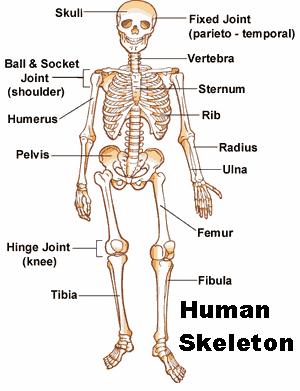
Click on the Skeleton to see a larger Picture.
|
The Human Skeletal System
The Skeletal System serves many important functions; it provides the shape and form for our bodies in addition
to supporting, protecting, allowing bodily movement, producing blood for the body, and storing minerals.
The 206 bones in the Human Body form a rigid framework to which the softer tissues and organs
of the body are attached.
Vital organs are protected by the skeletal system. The brain is protected by the surrounding skull as the
heart and lungs are encased by the sternum and rib cage.
Bodily movement is carried out by the interaction of the muscular and skeletal systems. For this reason,
they are often grouped together as the musculo-skeletal system.
Muscles are connected to bones by tendons.
Bones are connected to each other by ligaments.
Where bones meet one another is typically called a joint.
Muscles which cause movement of a joint are connected to two different bones and contract to pull them together.
An example would be the contraction of the biceps and a relaxation of the triceps. This produces a bend at the elbow. The
contraction of the triceps and relaxation of the biceps produces the effect of straightening the arm.
Blood cells are produced by the marrow located in some bones. An average of 2.6 million red blood cells are
produced each second by the bone marrow to replace those worn out and destroyed by the liver.
Bones serve as a storage area for minerals such as calcium and phosphorus. When an excess is present in the blood, buildup
will occur within the bones. When the supply of these minerals within the blood is low, it will be withdrawn from the bones
to replenish the supply.
|
|
|
|
"BEST OF THE BEST"
Ryoshin-Kan Karate School
"Home of the Dragon Force Demo Team."
(757) 468-1643
|